.jpg)
In all businesses, there will be a movement of goods and services into the business, goods, and services out of the business plus all the supporting functions such as receiving, payment, stores and despatch and in technical environments, repairs and services.
A technical administrator will routinely oversee a number of standard processes and procedures.
These might differ slightly between businesses, but the essence remains the same. Every technical environment will have its own version of standard processes and procedures so the basic procedure may have some additional requirements, or it may be pared down to something a lot simpler.
As a starting point, let us have a look at a simple diagram indicating how a business might operate.
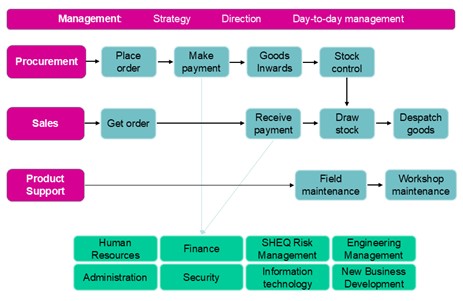
This is a retail business which makes profit from buying and selling goods.
As with all businesses there is a management layer which guides the running of the business.
This is supported by all the underlying functions necessary to keep the business going.The first basic process would be carried out by the Procurement department.
This would be placing an order with a supplier so that we have some goods to sell. This is not a simple process of calling or sending an email and simply requesting the product. Many large suppliers will not supply goods unless they have carried out proper financial checks and ensured that the prospective customer is going to pay the account.
Similarly, large suppliers will often not supply only one of a product and are looking to supply a Minimum Order Quantity (MOQ).Much of the business is about establishing a relationship between suppliers and our business. Once the relationship between supplier and business has been established, there will be a formal method of placing an order. This would consist of the procurement officer sending a Request for Quotation (RFQ) to the supplier.
The supplier would respond with a formal quotation, and this would then trigger an internal process in our business. This internal process would ensure that we have money available to pay for the goods. We would have our order signed off by management and then send a formal purchase order through to the supplier.
The supplier would send a proforma invoice, and we would pay the money into their bank account. Once the funds are cleared, the goods would be despatched to us.
When the goods arrive, we have a procedure to receive the goods and enter them into our stock system. This is called a Goods Inwards process. You can imagine that if we didn’t have this, the supplier could say he had delivered the goods to us and his driver could have dropped the goods off at his home. The supplier would have our money, and some stranger would have our goods, and we would not be able to prove a thing.
Once the goods are in our store, they must be captured into our computer system. This is called data capture.A similar set of procedures would follow when we receive an order from our customer.
If the goods are on the shelf, we want to receive payment prior to despatching the goods. We need processes for receiving money and entering it into a financial system. Then we need a process to draw the products from stock.The despatch process might also require that we deliver the goods to the customer, so we need to consider transport and how we keep track of the vehicles and drivers.
We must keep a record if the goods are very technical so that we can supply support services if required and also guarantee the product for a period.
So, you can see that a simple sale is often a very complicated procedure or set of procedures.
Where a product is designed and built specifically for a customer, the processes and procedures become very complex. It is here where the Technical Administrator is a vital component in the chain.
It is not possible for us to mention and discuss all the possible business processes, but we can touch on the main processes you are likely to encounter. We will cover processes in more detail under Quality Management Systems.
Companies must offer a guarantee with each product sold.
The Consumer Protection Act requires this.
Goods that fail may just need to be repaired. In this case they must be accepted into the workshop environment, labelled so that they are traceable, and after repair they must be returned to the customer.
When they are in the repair process, there is a different level of traceability required. Spare parts may be used, and hours of labour must be tallied. Goods under guarantee are repaired at company expense but records must still be kept so that the financial books balance.
Where goods are out of warranty or guarantee, repairs are still carried out, but these repairs are charged to the customer, so we have different process in place which includes a payment element.
The spare parts that are used must be sourced from a supplier, entered into stock, priced correctly, and stored so that they can be easily located. When they are used, they must be drawn from stock, records must be updated, and invoices must be generated.
This is definitely an environment that needs technical administration.
This procedure is also called Returned Merchandise Authorisation or Returned Goods Authorisation.
If any merchandise or materials are found to be defective or incorrectly ordered, normal procedure is to contact the supplier and request permission to send the merchandise back for repair, replacement or refund. This process may take some time and some negotiation but will invariably culminate in the supplier issuing an RMA that authorises the return of the goods. This ensures that goods are tracked and handled correctly at the premises of the supplier.
The RMA is normally numbered and dated and has particular conditions attached to it. These conditions may include an undertaking to repair or refurbish the goods, to replace with goods of similar value immediately or at some time in the future or refund the purchase price of the goods less a fee for handling and transport. If an RMA is not issued and the customer ships goods back to the company, it is very likely that the company will not accept the goods. This could result in the goods being held in a store somewhere with the customer severely prejudiced.
Some products that are delivered must be tested before being put into stock. In the case where the product is tested and it simply doesn’t switch on; we call that Dead on Arrival.
Most companies will provide an expedited replacement of the affected product as soon as they are informed. The supplier must however be informed officially and with the proper documentation. This requires an internal procedure.
Some suppliers require that the defective product be returned within a specific time period (e.g.10 days) so our internal procedure must make allowances for that.
Additional conditions may include that the purchaser may not withhold payment from the supplier.
The supplier may also have a different address to which the product must be delivered if they do not collect it themselves.
Products that fail within a specific period may normally be returned for credit.
This requires two procedures for our retail company.
We will probably have sold the product to our end user customer. This customer will have returned the product to us, so we have to give them credit. This is a financial procedure that will involve credit notes, possibly refund of cash and perhaps some credit card transactions.
Internally, we must return the product to our supplier which may involve a different procedure to the RMA procedure. Suppliers want to receive the product in a particular format so that they can use the information about the product failure to improve their production processes. The supplier will also have specific processes within his environment for returned goods.
The following procedures are dealt with in a future module: